Author: parmazon
-
Romans 6, Indicatives & Imperatives
The indicative and imperative are actually moods, not tenses — this is an important distinction in Greek (and in grammar generally). Mood expresses the speaker’s relationship to the action (how it’s being portrayed), while tense expresses time and aspect.
Indicative Mood
The indicative is the mood of assertion or statement of fact. It presents an action as actually occurring, having occurred, or as reality from the speaker’s perspective. It’s the most common mood in the Greek New Testament.
Examples:
- “Christ died for our sins” (1 Cor. 15:3) — ἀπέθανεν, aorist indicative, stating a historical fact
- “We have peace with God” (Rom. 5:1) — ἔχομεν, present indicative, stating a present reality
The indicative can occur in all the tenses (present, imperfect, future, aorist, perfect, pluperfect).
Imperative Mood
The imperative is the mood of command, exhortation, prohibition, or entreaty. It does not assert something as fact but issues a directive — it expresses the speaker’s will that something be done.
Examples:
- “Repent” (Mark 1:15) — μετανοεῖτε, present imperative
- “Be reconciled to God” (2 Cor. 5:20) — καταλλάγητε, aorist imperative
In Greek, imperatives occur primarily in the present and aorist tenses (rarely perfect), and the tense conveys aspect rather than time:
- Present imperative — typically ongoing, habitual, or continuous action (“keep on doing”)
- Aorist imperative — typically an action viewed as a whole, often a specific command (“do this”)
Theological Significance
The indicative/imperative distinction is foundational to Reformed exegesis of Pauline ethics. Paul consistently grounds imperatives (commands) in indicatives (realities of what God has done in Christ). Romans is structured this way: chapters 1–11 are heavy with indicatives (what God has accomplished), and chapters 12–16 issue the imperatives that flow from those realities. “Therefore, brethren … present your bodies a living sacrifice” (Rom. 12:1) — the imperative rests on the indicative foundation of chapters 1–11.
Ridderbos, Murray, and Herman Bavinck all emphasized this pattern: the imperative never stands alone but always presupposes the indicative of grace.
-
Resurrection Doctrines in Romans
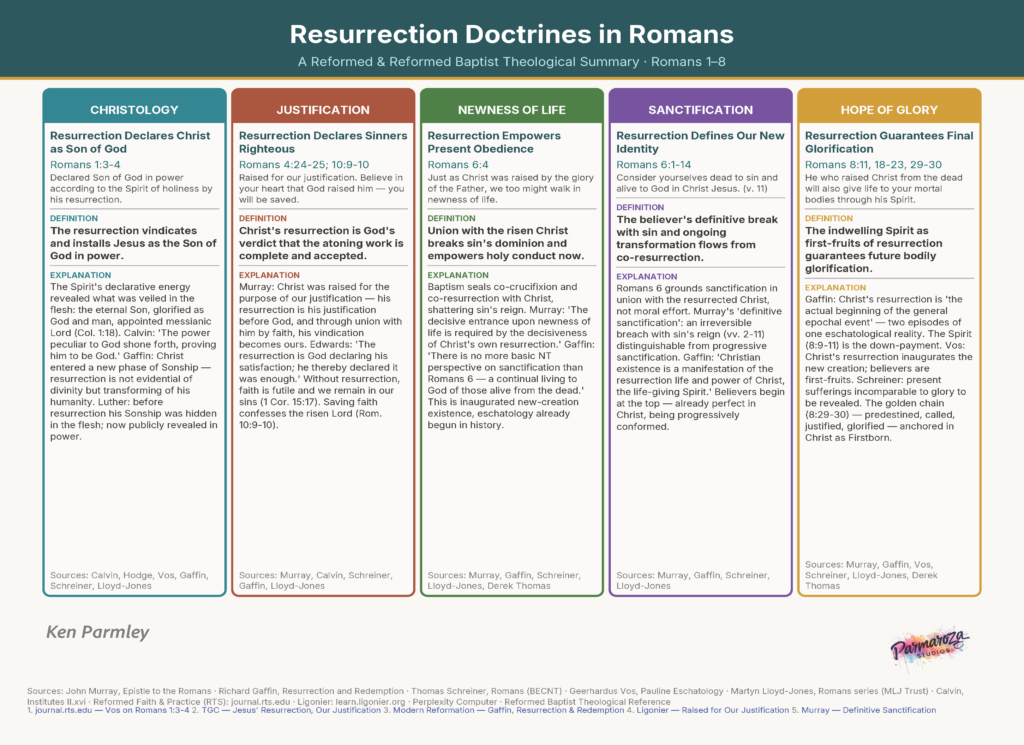
CHRISTOLOGY
Resurrection Declares Christ as Son of God
Romans 1:3-4
Declared Son of God in power according to the Spirit of holiness by his resurrection.
DEFINITION
The resurrection vindicates and installs Jesus as the Son of God in power.
EXPLANATION
The Spirit’s declarative energy revealed what was veiled in the flesh: the eternal Son, glorified as God and man, appointed messianic Lord (Col. 1:18). Calvin: ‘The power peculiar to God shone forth, proving him to be God.’ Gaffin: Christ entered a new phase of Sonship — resurrection is not evidential of divinity but transforming of his humanity. Luther: before resurrection his Sonship was hidden in the flesh; now publicly revealed in power.
Sources: Calvin, Hodge, Vos, Gaffin, Schreiner, Lloyd-Jones
JUSTIFICATION
Resurrection Declares Sinners Righteous
Romans 4:24-25; 10:9-10 Raised for our justification. Believe in your heart that God raised him — you will be saved.
DEFINITION
Christ’s resurrection is God’s verdict that the atoning work is complete and accepted.
EXPLANATION
Murray: Christ was raised for the purpose of our justification — his resurrection is his justification before God, and through union with him by faith, his vindication becomes ours. Edwards: ‘The resurrection is God declaring his satisfaction; he thereby declared it was enough.’ Without resurrection, faith is futile and we remain in our sins (1 Cor. 15:17). Saving faith confesses the risen Lord (Rom. 10:9-10).
NEWNESS OF LIFE
Resurrection Empowers Present Obedience
Romans 6:4
Just as Christ was raised by the glory of the Father, we too might walk in newness of life.
DEFINITION
Union with the risen Christ breaks sin’s dominion and empowers holy conduct now.
EXPLANATION
Baptism seals co-crucifixion and co-resurrection with Christ, shattering sin’s reign. Murray: ‘The decisive entrance upon newness of life is required by the decisiveness of Christ’s own resurrection.’ Gaffin: ‘There is no more basic NT perspective on sanctification than Romans 6 – a continual living to God of those alive from the dead.’ This is inaugurated new-creation existence, eschatology already begun in history.
SANCTIFICATION
Resurrection Defines Our New Identity
Romans 6:1-14
Consider yourselves dead to sin and alive to God in Christ Jesus. (v. 11)
DEFINITION
The believer’s definitive break with sin and ongoing transformation flows from co-resurrection.
EXPLANATION
Romans 6 grounds sanctification in union with the resurrected Christ, not moral effort. Murray’s ‘definitive sanctification’: an irreversible breach with sin’s reign (vv. 2-11) distinguishable from progressive sanctification. Gaffin: ‘Christian existence is a manifestation of the resurrection life and power of Christ, the life-giving Spirit.’ Believers begin at the top — already perfect in Christ, being progressively conformed.
HOPE OF GLORY
Resurrection Guarantees Final Glorification
Romans 8:11, 18-23, 29-30 He who raised Christ from the dead will also give life to your mortal bodies through his Spirit.
DEFINITION
The indwelling Spirit as first-fruits of resurrection guarantees future bodily glorification.
EXPLANATION
Gaffin: Christ’s resurrection is ‘the actual beginning of the general epochal event’ – two episodes of one eschatological reality. The Spirit (8:9-11) is the down-payment. Vos: Christ’s resurrection inaugurates the new creation; believers are first-fruits. Schreiner: present sufferings incomparable to glory to be revealed. The golden chain (8:29-30) — predestined, called, justified, glorified — anchored in Christ as Firstborn.
-
Psalm One
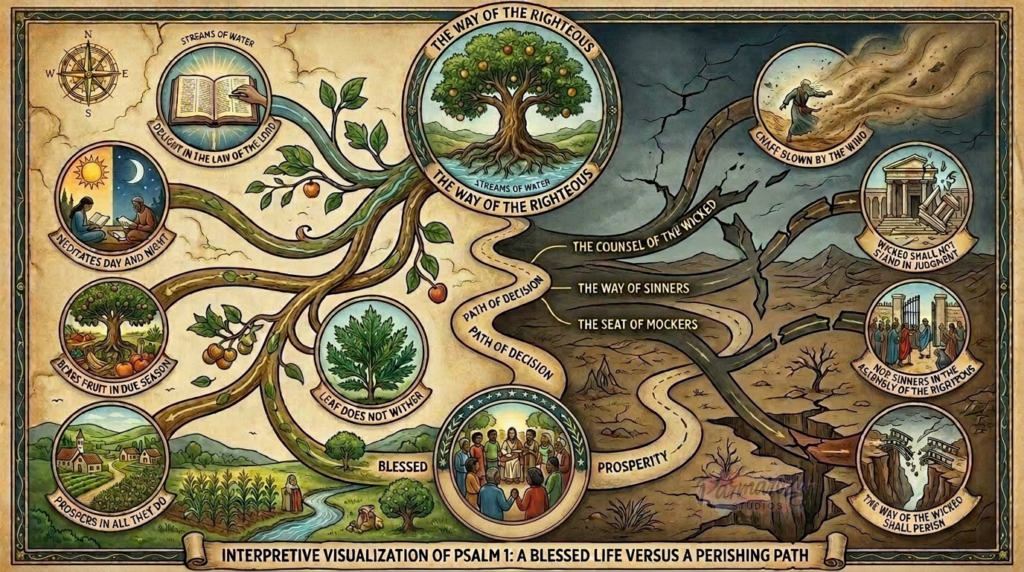
The Way of the Righteous and the Wicked
 1       Blessed is the man who walks not in the counsel of the wicked, nor stands in the way of sinners, nor sits in the seat of scoffers;
 2       but his delight is in the law of the LORD,  and on his law he meditates day and night.
3       He is like a tree planted by streams of water that yields its fruit in its season, and its leaf does not wither. In all that he does, he prospers.
4       The wicked are not so, but are like chaff that the wind drives away.
 5       Therefore the wicked will not stand in the judgment, nor sinners in the congregation of the righteous;
 6       for the LORD knows the way of the righteous, but the way of the wicked will perish.

The Holy Bible: English Standard Version (Ps 1:1–6). (2025). Crossway Bibles.